“Excellent customer service from start to finish. The Coyote Restoration team was extremely polite, respectful, and very patient.”
Mold Remediation in Fort Worth, TX
Fort Worth's humidity, foundation movement and AC condensation are the perfect storm for hidden mold. We find it, contain it, remove it, and document the moisture source so it can't grow back. IICRC-certified. EPA-aligned. Insurance-friendly.
Mold remediation · Fort Worth
Why Fort Worth has so much hidden mold
DFW averages 64% relative humidity year-round (NOAA), with summer dew points that put us in the same zone as parts of the Gulf Coast. Combine that with slab-on-grade construction, foundation movement that opens up plumbing leaks, and AC systems that run from April to October pulling water out of the air every minute — and you get conditions where mold doesn't need a flood event to grow. It just needs a leak you didn't know about.
The homes we work in across Fort Worth almost always fall into one of three categories: 1950s-1970s pier-and-beam houses around the Near Southside, Fairmount and Ridglea where ground-level moisture and poor crawl-space ventilation are the main drivers; slab-on-grade homes from the 1990s and 2000s in West, Southwest and far-North Fort Worth where foundation movement creates supply-line and drain-line leaks; and modern Alliance-area builds where a single roof leak or AC condensation issue gets ignored long enough for mold to colonize the affected wall cavity.
Our process is built around the ANSI/IICRC S520 standard for mold remediation and the EPA's "Mold Remediation in Schools and Commercial Buildings" guidance. That's the same protocol used by the largest national restoration brands — the difference is the local team and the willingness to show our work, line by line, on a written scope.
Mold species we identify most often in DFW homes
Stachybotrys chartarum (black mold)
Slimy, dark green or black. Grows on cellulose-rich materials (drywall, wood framing, ceiling tile) that have stayed wet for 7+ days. Most often found in Fort Worth homes after slow slab leaks under sinks and bathtubs, and after the 2021 and 2024 freeze-event burst pipes that weren't fully dried.
Aspergillus
Probably the most common indoor mold across DFW. Green, gray or yellow. Usually shows up in HVAC systems, attics, and bathrooms. Many species are common allergy triggers and the genus accounts for most of the elevated indoor spore counts we see in lab reports.
Cladosporium
Olive-green to brown. Thrives on damp fabrics, wood and around windows where condensation collects. Common in older Fort Worth homes (Fairmount, Bluebonnet Hills, Arlington Heights) with single-pane windows or original wood window frames.
Penicillium
Blue-green, often fuzzy. Spreads quickly through air ducts and shows up in water-damaged carpet pad and behind wallpaper. The species we tag most often in homes with prior, undisclosed water events.
Alternaria
Dark green or brown, velvety. Likes wet walls, showers, tubs, and around plumbing fixtures. Strong allergen trigger; commonly identified in homes with ongoing bathroom moisture issues and weak exhaust ventilation.
Chaetomium
White becoming gray then black, often described as cotton-like. Indicator species for severe water damage to drywall and wood. If we find Chaetomium, the moisture intrusion has been ongoing for a while.
Mold job documentation
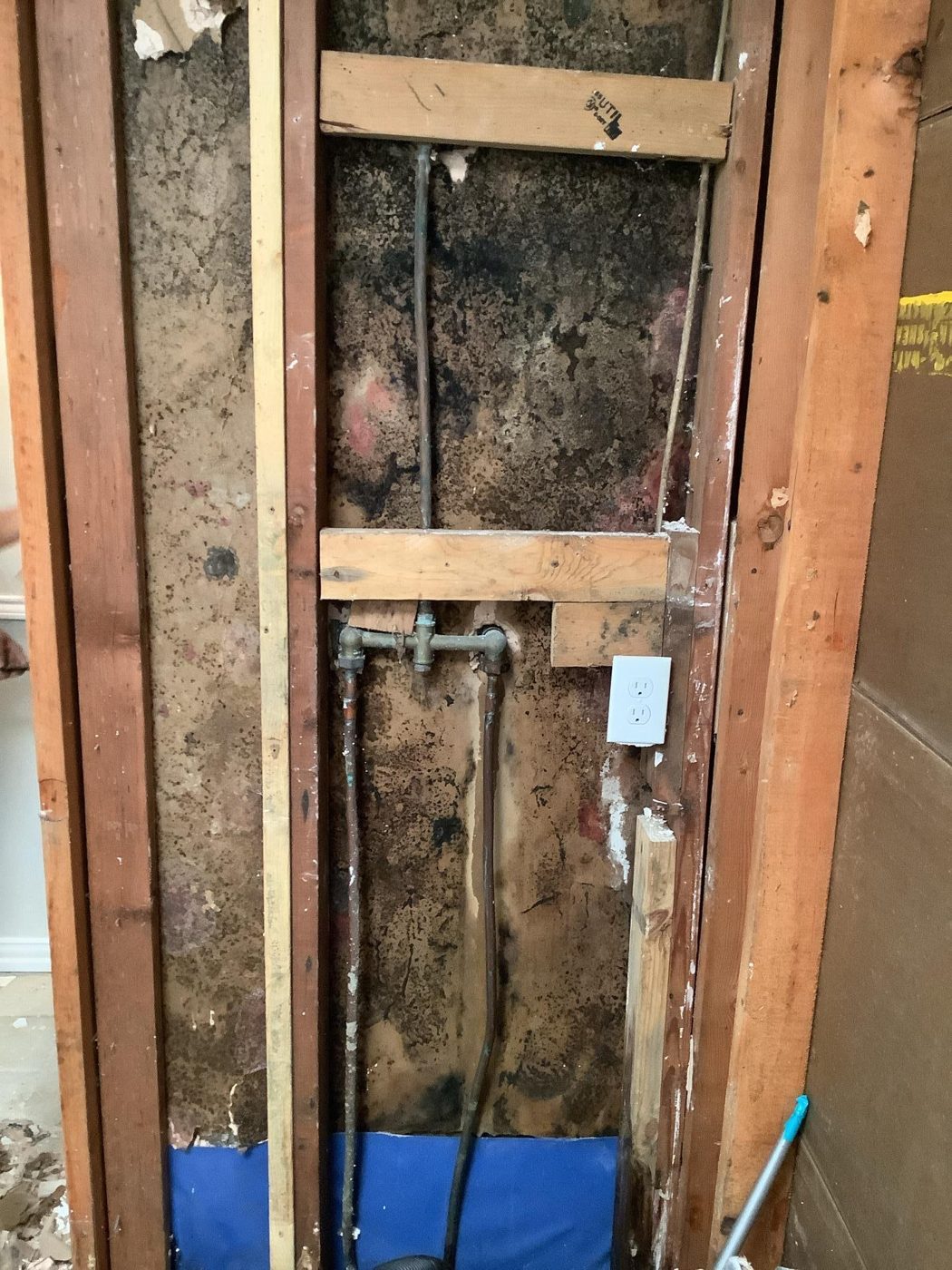
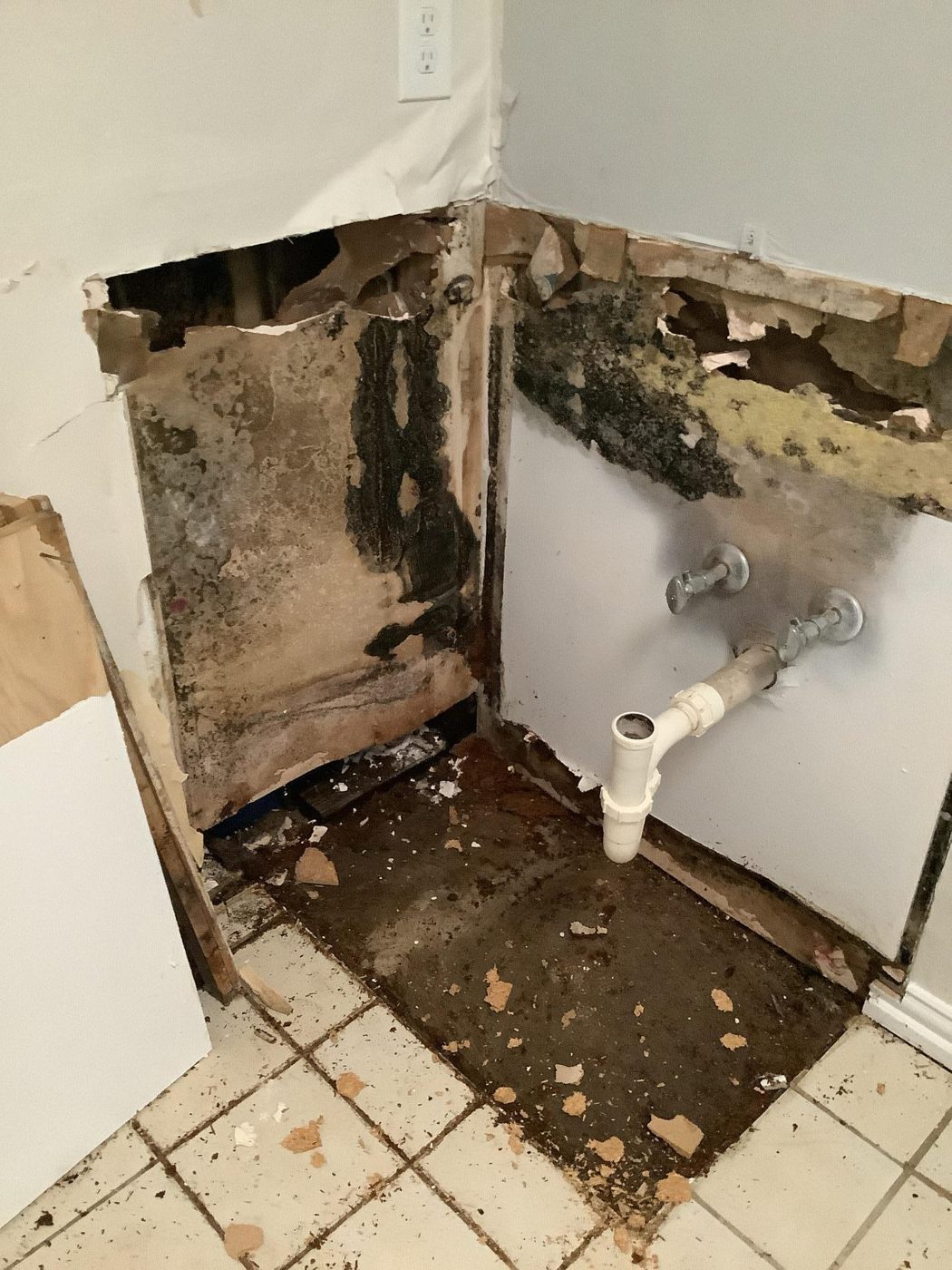
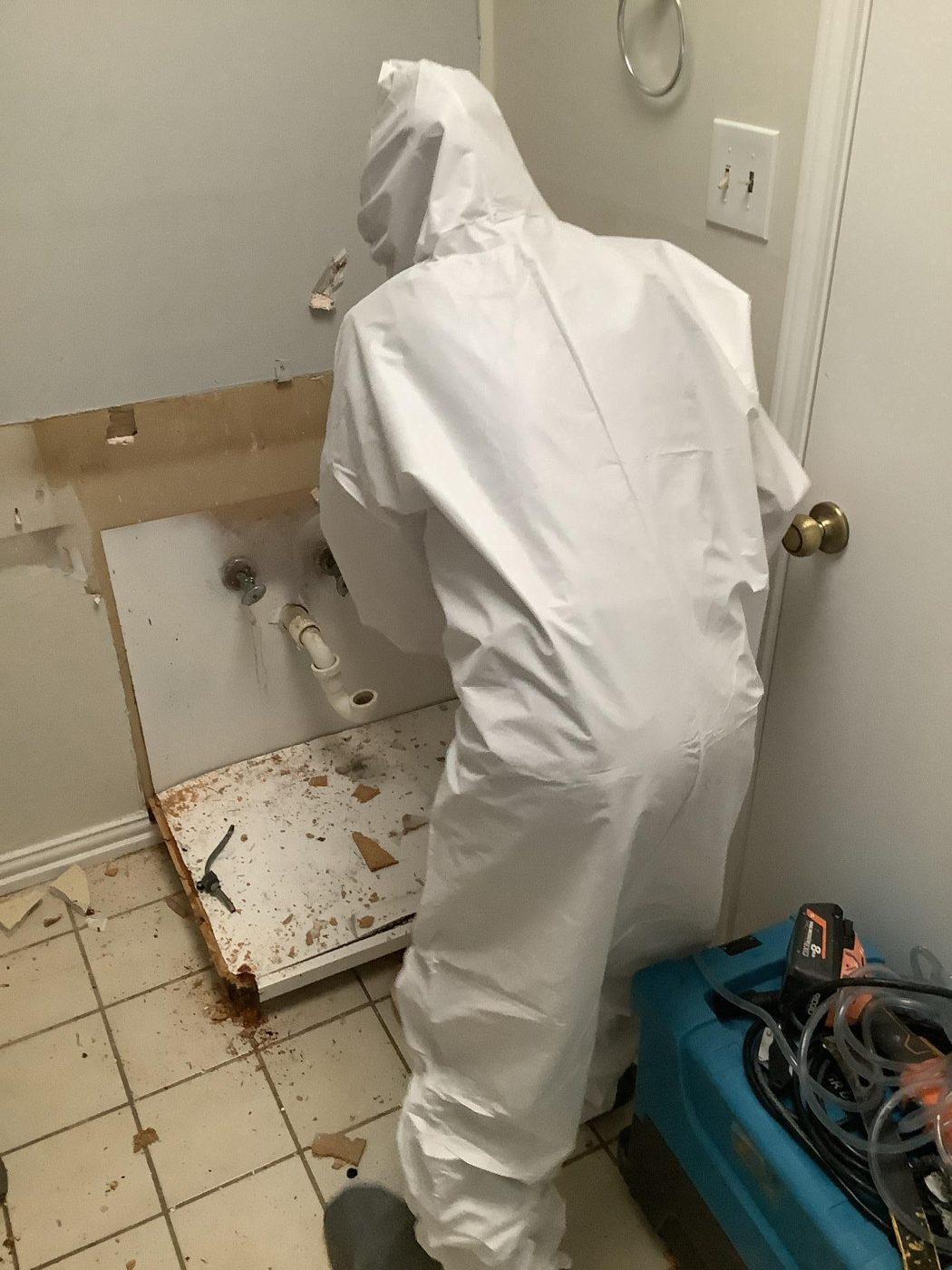
What our crews document before remediation starts
Clear project photos help scope containment, removal, drying and insurance documentation before affected materials are disturbed.
EPA-aligned process
How a Fort Worth mold remediation actually runs
No mystery, no surprises. Here's the step-by-step protocol every job follows — aligned with EPA "Mold Remediation in Schools and Commercial Buildings" and ANSI/IICRC S520 (the industry standard for mold remediation).
1. Initial assessment & scoping
Visual inspection, moisture mapping with infrared and pin meters, HVAC inspection. We document with photo and moisture-reading logs. If air-quality verification is needed, samples go to an AIHA-accredited lab.
2. Containment
6-mil polyethylene barriers seal the work area. Negative air pressure (HEPA-filtered air machines pulling air out of containment faster than it can leak in) keeps spores from migrating to clean parts of the home. Critical for limiting the scope and the cost.
3. PPE & HEPA filtration
Full-face respirators, Tyvek suits, gloves, boot covers. Industrial HEPA scrubbers run continuously, capturing spores down to 0.3 microns. The air inside containment ends up cleaner than the outdoor air.
4. Removal of contaminated materials
Affected porous materials (drywall, insulation, carpet pad, baseboards) are removed in 6-mil bags, double-sealed, and disposed at landfill. Salvageable surfaces (framing, subfloor, hard surfaces) get HEPA-vacuumed, wire-brushed where needed, and treated.
5. Antimicrobial treatment
EPA-registered antimicrobials applied to all remaining surfaces inside containment. We use products on EPA's List N where applicable, with documented dwell times. This step kills residual spores, not just visible growth.
6. Source-moisture fix
The most important step — and the one cheap remediation jobs skip. Slab leak, roof leak, AC condensation line, drainage issue, ventilation problem. Whatever caused the mold gets identified and fixed (by us or by your plumber/roofer/HVAC tech we coordinate with). If the moisture source isn't fixed, the mold grows back. Period.
7. Drying & clearance
Industrial dehumidifiers and air movers bring moisture readings back to dry standard for the materials involved. We monitor daily until readings hit target.
8. Post-remediation verification (PRV)
Final clearance check. Visual inspection plus air-quality samples (highly recommended for medium-to-large jobs, sometimes required by the insurance carrier). Independent third-party PRV is the gold standard.
9. Reconstruction
Drywall, insulation, flooring, baseboards, paint. Same crew, same job, same insurance scope — we don't hand you off to a separate GC.
Insurance & documentation
Will your Fort Worth homeowner policy cover mold remediation?
Texas homeowner policies typically cover mold remediation when the mold is the direct result of a sudden, accidental water event that's already covered — a burst supply line, an upstairs tub overflow, a dishwasher hose failure, a covered roof leak after a storm. Most policies include a separate mold sublimit (often $5,000-$10,000 of coverage by default, with higher limits available as a rider).
What usually isn't covered: long-term seepage, slow plumbing leaks the homeowner knew about, foundation-movement leaks where the foundation itself isn't a covered cause, and lack-of-maintenance damage. Texas-specific note: after the 2002 mold-claim crisis, most carriers in Texas added language carefully limiting mold coverage. We've read the policies. We document the loss either way — moisture maps, photo logs, scope-of-work reports, daily moisture readings, lab data — so your adjuster gets a clean file and you get a fair claim decision.
Carriers we work with daily on Fort Worth mold claims: Allstate, State Farm, Farmers, USAA, Travelers, Liberty Mutual, Progressive, Nationwide, American Family, Texas Farm Bureau, Foremost, MetLife. We bill direct to the carrier on covered work so most homeowners pay only their deductible, not the full project up front.
DIY vs professional
When you can clean it yourself — and when you can't
Per EPA guidance, surface mold under 10 square feet on non-porous materials (tile, glass, sealed countertops, finished metal) can usually be cleaned safely by a homeowner with detergent and water. PPE — gloves, N95, eye protection — is still required.
Professional remediation is the right call when:
- Affected area exceeds 10 sq ft (per EPA threshold)
- Mold is on porous materials (drywall, wood, carpet pad, insulation) where surface cleaning leaves the roots intact
- Mold is hidden inside walls, under floors, or in HVAC — touching it without containment will spread spores everywhere
- You suspect Stachybotrys, Chaetomium or other indicator species — different protocol required
- Anyone in the home has asthma, severe allergies, or compromised immunity
- The moisture source isn't obvious — surface cleaning without source-moisture fix means it grows back
- You're filing an insurance claim — DIY work doesn't generate the documentation a claim needs
The number-one mistake we see: homeowners spraying bleach on visible drywall mold, declaring it fixed, and calling us four months later when the same patch has come back four times bigger and now has Stachybotrys in it. Bleach kills surface mold on non-porous materials. On drywall and wood, it just discolors the surface and feeds the moisture problem.
Service Area
Mold remediation across DFW
Headquartered in North Richland Hills. Crews dispatched 24/7 across Fort Worth, North Richland Hills, Irving, Haltom City, Arlington, Hurst, Bedford, Euless, Trophy Club, Roanoke and Dallas.
Fort Worth
Dallas
North Richland Hills
Arlington
Irving
Haltom City
Hurst
Bedford
Euless
Trophy Club
Roanoke
City-specific mold pages: Dallas mold removal · Dallas mold inspection · Mold removal service overview · Commercial mold abatement
FAQ
Common Fort Worth mold questions
Common signs in Fort Worth homes: musty smells (especially when the AC kicks on), visible black, green or white patches, water stains around windows, baseboards that have separated from drywall, recurring allergy symptoms that improve when you're away from home, and unusually high humidity inside the house. A professional inspection — visual plus moisture mapping — is the only way to know for sure.
Depends on species and exposure. Most indoor molds (common Aspergillus, Cladosporium, Penicillium species) trigger allergy-type symptoms — cough, congestion, headaches, sinus pressure, eye irritation. Stachybotrys (black mold), Chaetomium and a few others can cause more serious respiratory issues, especially for kids, the elderly, asthmatics and people with compromised immunity. The right move is to keep distance from the visible growth until a certified inspector confirms what it is and how widespread it is.
Per EPA guidance, mold can begin to colonize within 24 to 48 hours of moisture exposure. Fort Worth's high summer humidity speeds that up — wet drywall in July is colonized faster than wet drywall in January. The window for preventing mold after water damage is small. That's why we push so hard on rapid extraction and structural drying within the first 24-72 hours of any water event.
Small jobs (single bathroom, under 10 sq ft of affected drywall): 1-3 days on-site, plus drying. Medium jobs (single room or HVAC system contamination): 3-7 days. Larger jobs that require reconstruction or affect multiple rooms: 1-3 weeks. Whole-home remediation after a major water event: 3-6 weeks. We give a written timeline at the scope walk-through and update it daily.
Not if the moisture source is fixed. Mold needs water to grow — remove the water, the mold can't return. The reason mold "comes back" after a cheap remediation job is that the moisture source was never identified and fixed. That's why our process spends so much time on the source-moisture step and why we won't close a job until the source is documented as fixed.
Sudden, accidental water events leading to mold (burst pipe, supply-line failure, dishwasher overflow, covered roof leak) are typically covered up to your policy's mold sublimit. Long-term seepage and lack-of-maintenance damage usually isn't. Texas policies often have specific mold language — we read the policy section before we file the scope and tell you exactly what's likely covered.
Yes — and for medium-to-large jobs we recommend third-party PRV (an independent inspector and lab, separate from us) as the gold standard. That's the only way to verify the work to a standard the insurance carrier and any future buyer of the home would accept without question.
We bill insurance directly
$0 out of pocket on covered claims.
We work directly with every major U.S. carrier — handling the documentation, adjuster calls, and paperwork from intake to final invoice. You sign one Authorization. We do the rest.
State Farm
Allstate
USAA
Farmers
Liberty Mutual
Nationwide
Travelers
Progressive
American Family
GEICO
Don’t see yours? We work with every major U.S. carrier. Call 682-758-1624 — we’ll confirm coverage and start your claim on the spot.
“From start to finish, they were professional, prompt, and incredibly thorough. They handled every detail.”
“They worked with insurance to make sure our damage was restored to exactly how it was before.”
Get help now
Tell us what you're seeing.
Send a photo or describe what you found. We'll tell you what it is, what it'll take to remove, and how to keep it from coming back. Free in-home assessment for Fort Worth and DFW homeowners.
Call 682-758-1624
- Live person answers — 24 / 7 / 365
- Specialist on-site within 60 minutes
- We bill insurance directly — no upfront cost
IICRC certified · Licensed & insured · DFW family-owned